
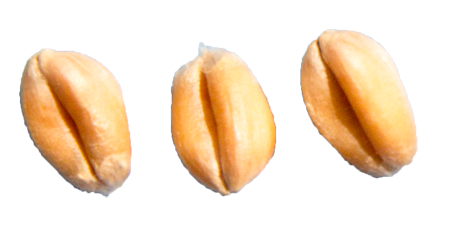
Common wheat and Durum wheat
The different characteristics between the two great families of wheat are due to the specifications of the kernel in milling and the destination use:
- The kernel of common wheat has a fracture surface powdery, white and opaque by milling and sifting process to produce flour.
- The kernel of durum wheat has a fracture surface vitreous, translucent and transparent, from the milling and sifting are obtained semolina
In Italy there are many cultivated varieties, certainly a heritage of quality and value, but the only deficiency are variety in particular with low and poor quality of gluten. This implies the need to import high quality varieties to complement our national product (in particular US and Canadian varieties) especially for common wheat.
The grain composition [su_spoiler title=”click to see the composition” icon=”arrow”]
- 83% endosperm intended to milling to obtain flour (Common wheat) semolina (Durum wheat)
- 15% casing from which we get the bran
- 2% embryo to a lesser measure falls to be part of the flour[/su_spoiler]
The endosperm composition [su_spoiler title=”click to see the composition” icon=”arrow”]
- 79% starch
- 14% protein
- 2,3% fibre
- 2,3% fat
- 2% ashes[/su_spoiler]
The average starch content of the Durum wheat is higher than that of the Common wheat.
Grain quality
The quality must be understood in reference to the different applications of flour: bread, pasta, biscuits, cakes.
Common wheat
Important parameters for assessing the quality of the grain:
[su_spoiler title=”click to see the parameters” icon=”arrow”]
- varietal uniformity
- moisture (affects conservation and made into flour)
- ash content of flour (essentially dependent on the percentage of endosperm of the kernel and the average weight for the kernel)
- protein content (influence, together with the gluten content, although not exclusively, the bakery and pasta product)
- quality and quantity of gluten (directly influence the quality of the product, while the quality of the gluten present depends on two physical characteristics of gluten same tenacity and elasticity, that contribute to the technological abilities of the product.)[/su_spoiler]
The quality and the technology abilities of wheat are evaluated by laboratory tests that provide indices of the quality of the product.
The most significant indices are:[su_spoiler title=”click to see indices” icon=”arrow”]
- moisture in the kernel
- ash content
- alveografica analysis
- evidence of bread making
- content of nitrogenous substances[/su_spoiler]
The alveografica analysis in particular allows to derive two important indices:
- P / L ratio of tenacity and elasticity (optimal value between 0.4-0.6 over 0.6 we will have a hard bread, compact and of little mixing development, while under 0.4 a sticky dough and soft.)
- W index extensibility of the dough that allows the collocation of the wheat according to the products derived from them.
W index:[su_spoiler title=”click to see the classification” icon=”arrow”]
- Cookies 70-100W
- White bread 150-170W
- Breadsticks 200-250W
- Bread 250-270W
- Cakes 300W[/su_spoiler]
Durum wheat
The references are largely similar to the Common wheat.
Among the principal qualitative characteristics:
- Milling quality (weight, percent of damaged kernels, ashes)
- Attitude to the pasta (P/L 180, W 150)
- Pigmentation
This post is also available in:

